- Global Markets Investor
- Posts
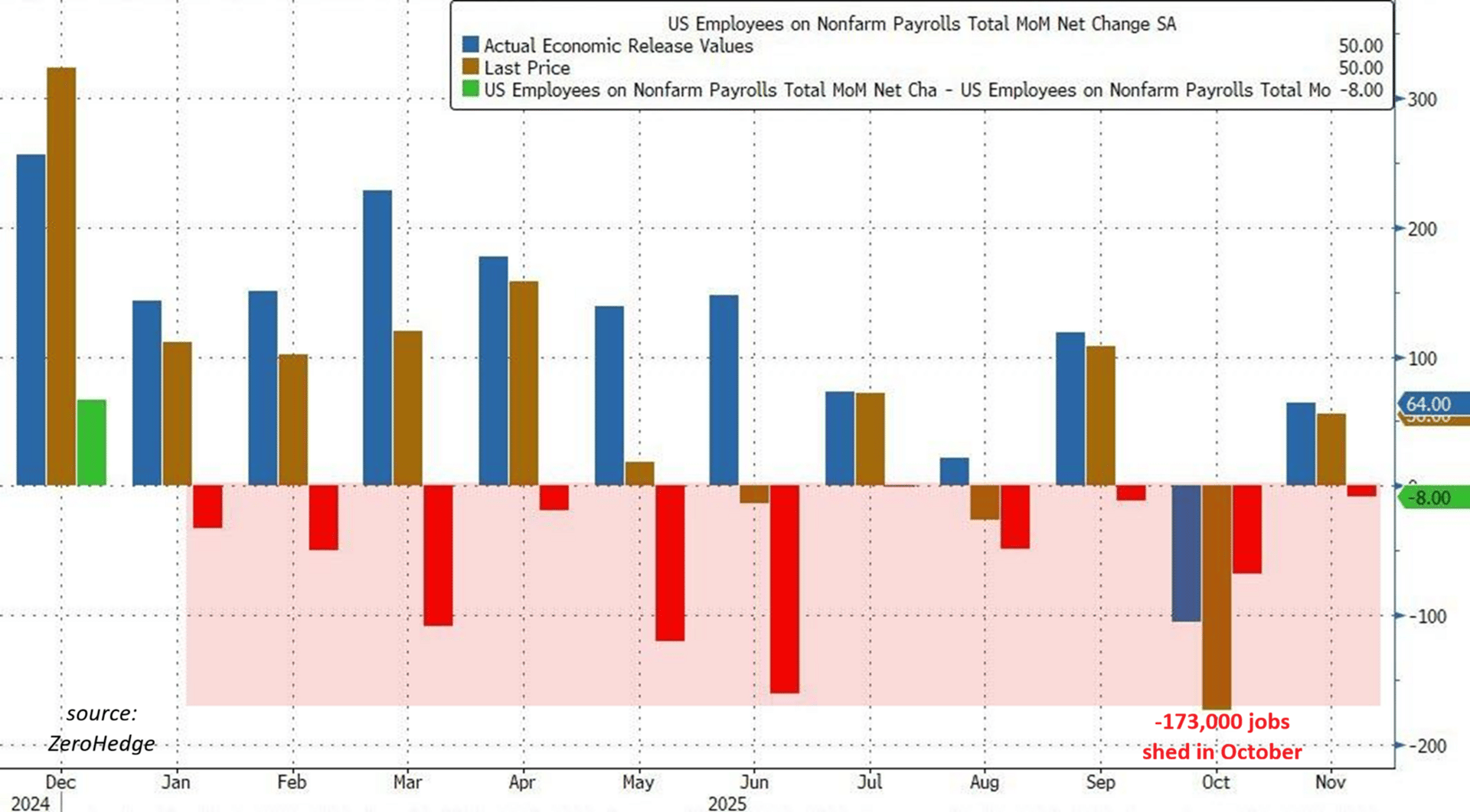
- ⚠️CHART OF THE WEEK: US nonfarm payrolls have been revised in each month of 2025
⚠️CHART OF THE WEEK: US nonfarm payrolls have been revised in each month of 2025
The US job market data is broken.

Global Markets Investor
January 10, 2026
In partnership with

🔥GLOBAL MARKETS INVESTOR’S PORTFOLIO IS UP +72% SINCE JANUARY 2024
DURING THE MARCH-APRIL 2025 MARKET TURMOIL, MAJOR US INDEXES FELL NEARLY 20%, WHILE THE GMI PORTFOLIO GAINED OVER 5%, FIND OUT HOW BELOW:

US nonfarm payrolls have now been revised in all 11 months of 2025 (red bars on the below chart).
As a result, evisions last year erased a total of –624,000 jobs, an average cut of -56,728 per report. By comparison, in 2024, the average downward revision was -30,000 jobs per month.
The headlines that actually moves markets

Tired of missing the trades that actually move markets?
Every weekday, you’ll get a 5-minute Elite Trade Club newsletter covering the top stories, market-moving headlines, and the hottest stocks — delivered before the opening bell.
Whether you’re a casual trader or a serious investor, it’s everything you need to know before making your next move.
Join 200K+ traders who read our 5-minute premarket report to see which stocks are setting up for the day, what news is breaking, and where the smart money’s moving.
By joining, you’ll receive Elite Trade Club emails and select partner insights. See Privacy Policy.
October was revised by -68,000, to -173,000, making it the worst month for payrolls since December 2020.

If this average pace holds, December would be revised to down to –6,700 from the Friday’s reported +50,000.
This also does not reflect annual benchmark revisions, for which initial numbers will be released during the summer. This may show that nonfarm payrolls actually declined -633,000 in 2025 due to the broken methodology and the Birth-Death model.
The Birth-Death model is a statistical plug the Bureau of Labor Statistics uses to estimate how many jobs come from new businesses "being born" and how many disappear when businesses "die." Because these figures cannot be measured in real time, the model fills the gap with assumptions, which can be very wrong, especially at turning points in the economy.
After 2020, the Birth-Death model became much less reliable because the pandemic fundamentally disrupted business formation patterns. Business applications surged to unprecedented levels, way above pre-pandemic rates and remaining elevated through 2024. However, these new businesses hired far fewer employees than historical averages, creating volatility the model could not anticipate.
The BLS explicitly acknowledged that "since the 2020 benchmark, CES estimates have been subject to persistent and relatively large birth-death forecast errors."
Over the last 30 years, such a decline in jobs has been seen only during the Great Financial Crisis in 2008 and 2009 and in the 2020 Crisis.
Full analysis of the US job market will be released early next week.


If you find it informative and helpful, consider a paid subscription or become a Founding Member, and follow me on Twitter or Nostr:
Reply